Fertilising indoor plants is one of the most misunderstood parts of houseplant care. Too little and growth stalls; too much and you scorch the roots. Get the balance right and your plants grow fuller, greener and more resilient — without the burnt leaf tips that come from a heavy hand.
This guide is for Singapore plant owners who want healthier indoor plants but are unsure what fertiliser to use, how much, and how often. You’ll learn the basics of plant feeding, the main fertiliser types, and how to read the signs of over- and under-feeding.
Why indoor plants need feeding
Outdoors, soil is constantly replenished by decaying matter and a wide root run. A potted plant has none of that — it is confined to a small volume of mix, and every watering flushes some nutrients out of the drainage holes. Over time the soil is depleted, and feeding tops up what the plant has used.
Understanding the numbers (N-P-K)
Most fertilisers carry three numbers, the N-P-K ratio, representing the main nutrients:
- N — Nitrogen drives leafy, green growth.
- P — Phosphorus supports roots and flowering.
- K — Potassium aids overall health and resilience.
For most foliage houseplants, a balanced fertiliser (roughly equal numbers) works well. Flowering plants benefit from a slightly higher phosphorus content, while leafy plants appreciate a touch more nitrogen.
Types of fertiliser for indoor plants
Liquid fertiliser
The most popular choice indoors. You dilute it in water and apply it when watering, giving you precise control. Easy to dial back or skip — ideal for beginners.
Slow-release granules or pellets
Mixed into the soil, these release nutrients gradually over weeks or months. Convenient and low-effort, but you cannot easily reduce the dose once applied.
Organic options
Worm castings, compost and seaweed-based feeds release nutrients gently and improve the soil. They are forgiving and harder to overdo, though they act more slowly.
How much and how often
The golden rule of fertilising indoor plants is to err on the light side. A common safe approach with liquid feed is to dilute to about half the strength stated on the label and feed roughly monthly during active growth.
- Always water-in or apply feed to damp, not bone-dry, soil to avoid root burn.
- Feed actively growing plants; slow-growing or dormant plants need little or none.
- Never feed a stressed, sick or recently repotted plant — wait until it is growing healthily.
The Singapore factor: feed to the light, not the season
Overseas guides talk about feeding in spring and summer and stopping in winter. Singapore has no real winter, so the calendar matters far less here than light does. Indoor plants grow steadily through the year, but their pace is set by how much light they receive.
A plant in a bright, well-lit spot is growing actively and uses more feed; a plant in a dim, shaded corner grows slowly and needs very little — over-feeding a low-light plant simply leads to salt build-up and burnt tips. So match feeding to growth: feed brighter, faster-growing plants more regularly, and barely feed those sitting in shade. Fresh potting mix already contains nutrients, so hold off feeding for the first month or two after repotting.
Signs of over- and under-feeding
Over-feeding
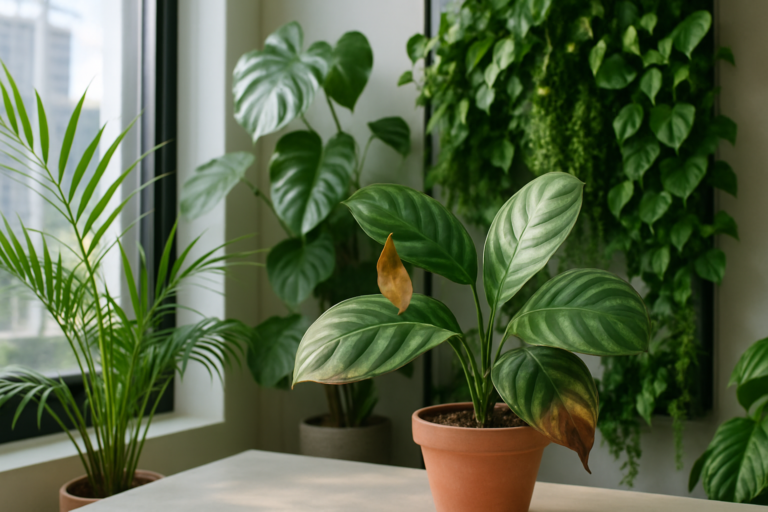
- Brown, crispy leaf tips and edges.
- A white crust of salts on the soil surface or pot rim.
- Wilting despite moist soil, as built-up salts damage roots.
If you suspect over-feeding, flush the pot thoroughly with plain water several times to wash out excess salts, and pause feeding.
Under-feeding
- Pale, yellowing leaves, especially older ones.
- Slow or stalled growth and small new leaves.
- A generally tired, lacklustre look despite good light and watering.
Frequently asked questions
How often should I fertilise indoor plants in Singapore?
For most foliage houseplants, a diluted liquid feed roughly monthly during active growth works well. Because we have no true winter, feed according to light and growth rather than the season — more for bright, fast-growing plants, very little for those in shade.
What fertiliser is best for houseplants?
A balanced liquid fertiliser suits most foliage plants and gives you the best control. Diluting to about half strength is a safe starting point. Slow-release granules are convenient, while organic feeds like worm castings are gentle and hard to overdo.
Can you over-fertilise indoor plants?
Yes, and it is common. Over-feeding shows as brown crispy leaf tips, a white salt crust on the soil, and wilting despite moist soil. If this happens, flush the pot with plain water several times and stop feeding until the plant recovers.
Should I fertilise a newly repotted plant?
No, not straight away. Fresh potting mix already holds nutrients, and a recently repotted plant is recovering. Wait a month or two until it is growing healthily before you begin feeding.
Want lush, well-fed indoor plants without the guesswork? Our team selects, feeds and maintains indoor greenery tailored to Singapore homes and offices. Explore our indoor landscaping services, browse our project work, or get in touch for a maintenance plan.