
Before you transform your outdoor space, it pays to understand the landscaping rules in Singapore that apply to your property type. What you can do with a landed garden, a condo balcony and an HDB corridor differs enormously — and getting it wrong can mean removal orders, disputes or wasted money.
This guide explains, in plain terms, what’s typically allowed for HDB, condominium and landed homes, where you’re likely to need approval, and how to avoid the common pitfalls. It’s general guidance, not legal advice — always check with the relevant authority or your managing agent before starting work.
Why the rules differ by property type
The core reason is ownership and shared space. A landed home gives you the most control over your own land; a condo involves shared property and a managing body; an HDB flat sits within public housing with its own guidelines. Broadly:
- Landed homes — most freedom, but still subject to authority approvals for certain works.
- Condominiums — governed by the MCST and by-laws, with common property tightly controlled.
- HDB flats — guided by HDB rules, especially for corridors and external areas.
Knowing which framework applies to you is the first step to planning sensibly.
HDB landscaping: what’s allowed
HDB residents have the least private outdoor space, but greenery is still very possible with care. Inside your flat and on your service yard, you have broad freedom for potted plants and indoor greenery. The grey areas are the common corridor and any external surfaces.
Corridors and external areas
- Potted plants along the corridor are generally tolerated if they don’t obstruct the walkway or fire access — keep a clear path at all times.
- Plants must not be placed where they could fall, and overwatering that drips onto floors below causes disputes.
- Anything fixed to walls, railings or external surfaces, or placed outside the flat boundary, may not be permitted — check HDB guidance first.
For HDB homes, the safest and most rewarding route is indoor and balcony-style greenery. Our indoor landscaping service can green a flat beautifully without touching common areas.
Condo landscaping: the MCST factor
In a condominium, the dividing line is private versus common property. Inside your unit and on your private enclosed space (PES) or balcony you have reasonable freedom, but the rules are set by your MCST’s by-laws and they vary between developments.
Balconies and private enclosed spaces
- Potted plants and movable planters within your balcony or PES are usually fine.
- Anything fixed to or hung over the railing typically needs MCST approval for safety and uniform appearance.
- Permanent structures, decking or built planters on a PES often need approval and must meet building and waterproofing requirements.
Common areas — the shared gardens, pool surrounds and grounds — are the MCST’s responsibility, not individual residents’. If you manage or sit on a council and want to upgrade these, that’s a managed-agent decision handled as a proper project. Our outdoor landscape and construction service works with MCSTs on exactly this kind of common-area improvement.
Landed homes: freedom with limits
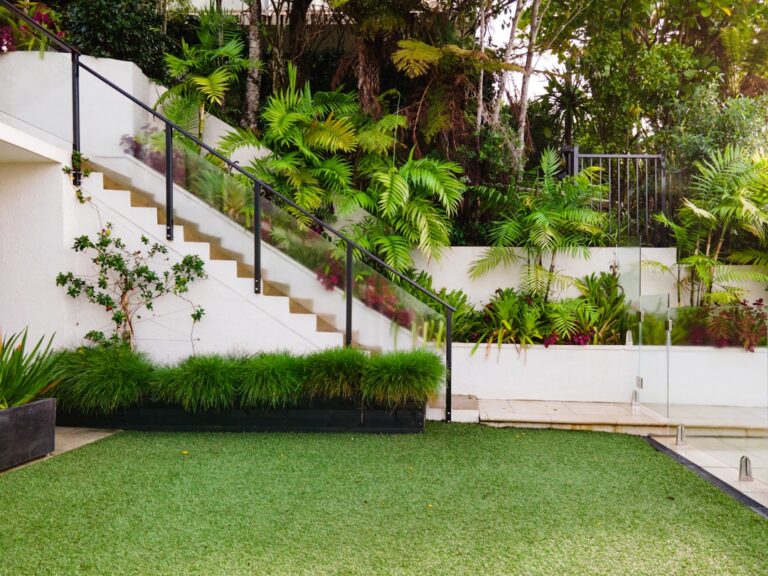
Landed homeowners have the most scope — you can redesign your garden, add decking, build planters, install water features and plant freely. But “your land” still comes with limits. The most common situations needing care are:
- Trees — removing or heavily pruning certain trees, particularly larger or mature ones, may require approval, and there can be rules around trees near boundaries.
- Boundary structures — walls, fences and gates may have height and setback requirements.
- Drainage and earthworks — significant level changes or works affecting drainage may need attention to avoid affecting neighbours.
- Built structures — substantial structures, large decks or roofed areas can need building approval.
The freedom is real, but it’s worth confirming what applies before major works rather than after.
The Singapore angle: trees, water and neighbours
A few themes run across all property types in Singapore. Trees are taken seriously — NParks oversees a great deal of greenery, and works affecting protected or boundary trees can need approval regardless of property type. If a project involves removing or relocating a sizeable tree, professional tree pruning and arboriculture services can advise on what’s permissible and handle it safely.
Water is the other constant. Our heavy rainfall means any landscaping that changes levels or surfaces must consider where water goes — poorly planned works that flood a neighbour or block drainage cause disputes fast. And because so much living here is shared or close-quarters, being a considerate neighbour matters: dripping plants, overhanging branches and noisy works all spark friction. Planning works properly, with the right approvals and good drainage, keeps the whole project smooth. When in doubt, an experienced contractor who knows Singapore’s conditions will flag what needs approval before you commit.
A simple checklist before you start
- Identify your property type and who governs it (HDB, MCST, or authority approvals for landed).
- Check the rules — HDB guidance, your MCST by-laws, or relevant authority requirements.
- Flag the high-risk items — trees, railing fixtures, structures, drainage and boundaries.
- Get approval first where needed, before any work begins.
- Use a contractor familiar with Singapore rules who can advise as part of the project.
Frequently asked questions
Can I put plants in my HDB corridor?
Generally yes, as long as they don’t obstruct the walkway or fire access and you keep a clear path. Avoid fixing anything to walls or railings, and prevent water dripping onto floors below. Check current HDB guidance, as it can change.
Do I need MCST approval to add decking to my condo balcony?
Usually yes. Permanent decking, built planters or structures on a balcony or PES typically need MCST approval and must meet waterproofing and building requirements. Movable pots and planters within the space are normally fine without approval.
Can I remove a tree in my own landed garden?
Not always freely. Removing or heavily pruning certain trees — particularly larger, mature or boundary trees — may require approval. It’s best to check before any work and to use an arborist who understands the requirements.
Who is responsible for landscaping in condo common areas?
The MCST, not individual residents. Common gardens, pool surrounds and grounds are shared property maintained and upgraded as managed decisions. Residents can only landscape their own private balcony or PES, subject to the by-laws.
Not sure what’s allowed for your property — or what needs approval? We work across HDB, condo and landed homes and can advise on the rules before planning your project. Explore our full range of landscaping services or get in touch for guidance.