
Standing water after rain is one of the most common complaints we hear from Singapore homeowners, and it is rarely just an eyesore. Puddles that linger for hours on your lawn, patio or driveway are a sign that water has nowhere sensible to go. Left unaddressed, they breed mosquitoes, rot timber, kill grass and slowly undermine paving and foundations.
This guide explains why water pools the way it does in our tropical climate, how to tell a minor issue from a serious one, and the practical drainage fixes that genuinely solve the problem rather than masking it.
Why water pools in Singapore gardens
Singapore gets heavy, intense rainfall all year round. A single afternoon storm can drop more water in an hour than many temperate climates see in a week. Your garden has to absorb or shed that water quickly, and several factors decide whether it can.
- Soil type. Much of our urban soil is heavy clay or compacted fill left over from construction. Clay holds water and drains slowly, so the surface stays saturated long after the rain stops.
- Compaction. Foot traffic, parked cars and heavy equipment squeeze air out of the soil. Compacted ground behaves almost like concrete and refuses to soak up water.
- Poor levels. If the ground slopes towards the house, or sits in a shallow dish, water collects at the lowest point with nowhere to escape.
- Blocked or missing drainage. Silted-up channels, leaf-clogged gullies or simply no drainage at all will leave water sitting on the surface.
Do a simple percolation test first
Before spending money, find out how badly your soil actually drains. Dig a hole roughly 30cm wide and 30cm deep, fill it with water and let it drain fully. Fill it a second time and time how long it takes to empty.
- Under an hour: drainage is healthy.
- One to four hours: slow, but often improvable with aeration and soil work.
- More than four hours, or overnight: you almost certainly need engineered drainage.
Doing this in a few spots tells you whether the problem is the whole garden or one stubborn low corner.
Quick fixes for minor pooling
If water clears within a few hours and the affected area is small, you may not need major works. Start with these.
Aerate compacted lawns
Pushing a garden fork deep into the turf, or hiring a core aerator for larger lawns, opens channels for water to drain and air to reach the roots. On heavy clay, top-dress afterwards with a sandy loam to keep those channels open.
Improve the soil
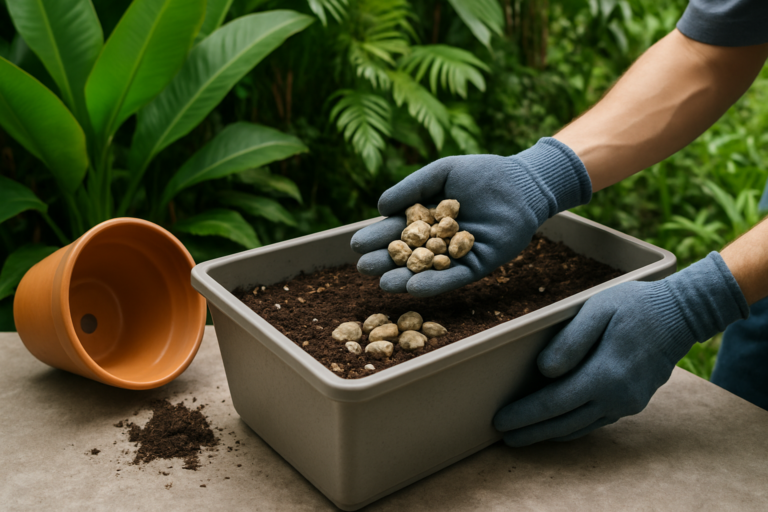
Digging in compost and coarse sand improves the structure of clay soil so it drains faster and holds less standing water. This is slow, incremental work, but it makes a real difference in planting beds.
Clear what you already have
Many “drainage problems” are simply blocked drains. Lift the gratings on your scupper drains and gullies, clear out leaves, silt and roots, and flush them through. In Singapore’s climate, leaf litter accumulates fast, so this should be a regular task.
Engineered drainage solutions
When pooling is persistent, widespread, or threatening your home, surface tweaks will not be enough. These are the solutions a professional landscaper will consider.
Channel and linear drains
A channel drain set across a driveway, patio edge or the base of a slope intercepts surface water and carries it away to a discharge point. These are the workhorse of hardscape drainage and are well suited to our paved outdoor areas.
French drains
A French drain is a gravel-filled trench with a perforated pipe that collects water from waterlogged ground and redirects it. It is ideal for soggy lawns and the boundary between a garden and a wall where water tends to sit.
Re-grading and soakaways
Sometimes the only real cure is to re-shape the ground so water flows away from the house towards a drain, planting bed or soakaway pit. A soakaway lets collected water disperse slowly into the subsoil, which is useful where there is no nearby outlet to connect to.
Rain gardens and planted swales
Instead of fighting the water, you can design for it. A rain garden is a planted depression that collects run-off and lets it soak away gradually, planted with species that tolerate both wet and dry spells. It turns a problem corner into a feature, which suits Singapore’s emphasis on greenery.
The Singapore angle: drainage, MCSTs and approvals
Drainage here is not purely a private matter. In landed homes, your surface water generally needs to discharge to the public drainage system in a controlled way, and you should not simply divert it onto a neighbour’s land. Any works that connect to or alter public drains may need approval, so it is worth checking before you dig.
For condominium and strata residents, standing water on common property, planter decks or podium gardens is usually the MCST’s responsibility, and waterproofing membranes complicate any work. If you manage a strata development, persistent ponding on a roof garden or podium should be investigated quickly because trapped water above a waterproofing layer can lead to expensive leaks below.
Whatever the property type, proper drainage works should always be designed alongside the surrounding hardscape and planting. Our team often combines drainage with civil and hardscape works so that new paving, kerbs and channels all shed water correctly from the start.
How much does fixing it cost?
Costs vary enormously with the scale of the problem and the solution. As a rough guide, clearing and minor regrading is relatively modest, while installing channel drains, French drains or a soakaway across a larger garden is a more substantial investment because of the excavation, pipework and reinstatement involved. The honest answer is that a proper site assessment is the only way to give a meaningful figure, because the cause is often hidden below the surface.
Frequently asked questions
Why does water sit on my lawn for hours after rain?
The usual culprits are compacted, heavy clay soil and a lack of fall towards a drain. Water cannot soak in fast enough and has nowhere to run off, so it sits. Aeration and soil improvement help mild cases, but persistent ponding normally needs proper drainage.
Is standing water after rain dangerous?
It can be. Stagnant water is a breeding ground for mosquitoes, which is a real concern in Singapore, and prolonged saturation rots plant roots and timber and can damage paving and foundations. Clearing puddles within a day or two should be the goal.
Can I fix drainage myself?
You can certainly clear blocked drains, aerate the lawn and improve soil yourself. Installing channel drains, French drains or re-grading the ground involves levels, falls and a legal discharge point, so it is usually better handled by a professional to avoid simply moving the water somewhere else.
How long do drainage works take?
A small French drain or a single channel run might be done in a day or two. Re-grading a garden, fitting multiple drains and reinstating turf or paving takes longer. Wet weather can also slow works, so some flexibility helps.
If standing water after rain keeps ruining your garden, we can find the real cause and fix it properly. Explore our drainage works or get in touch for a site assessment and we will recommend the most cost-effective way to keep your outdoor space dry.