
A garden path does more than get you from A to B. It shapes how you move through a garden, frames the views, and ties the whole design together. The right pathway feels effortless and looks like it belongs; the wrong one is slippery, awkward or simply forgettable. These garden pathway ideas will help you choose materials and a design that work for your space and Singapore’s climate.
This guide is for homeowners planning or upgrading garden paths. You will learn the main material options and their trade-offs, how to design a path that flows, and the practical points — drainage, slip resistance, durability — that matter most in our conditions.
What a good path does for a garden
- Guides movement and protects lawns and beds from being trampled.
- Creates a journey — a winding path invites you to explore, a straight one feels formal and direct.
- Defines spaces, separating lawn from beds, or one garden zone from another.
- Sets the style, since the material and pattern strongly influence the garden’s character.
- Improves safety with firm, even, non-slip footing.
Pathway materials compared
Natural stone and pavers
Stone paving and slabs give a solid, premium finish and last well. They suit formal and contemporary gardens, come in many textures and colours, and offer a stable surface. The main consideration in Singapore is slip resistance — smooth, polished stone gets dangerously slippery when wet, so a textured or honed finish is wiser.
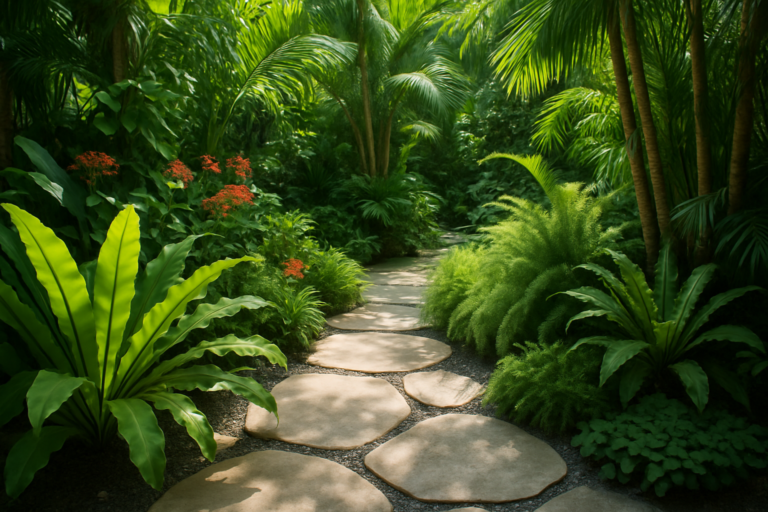
Stepping stones
Individual stones set into lawn or gravel create a relaxed, natural look and let greenery grow between them. They are ideal for low-traffic routes and informal gardens. Spacing them to a comfortable stride is the key to getting them right.
Gravel and aggregate
Gravel is affordable, drains freely and gives a pleasant crunch underfoot. It suits cottage and naturalistic styles. The trade-offs are that it scatters, needs edging to contain it, and is harder for wheels and heels. A compacted, well-edged gravel path performs far better than a loose one.
Timber and composite
Timber boardwalks and composite paths bring warmth and work beautifully over uneven ground, around water or linking decked areas. They must be specified for our humidity and rain, and surfaces should be chosen for grip. Our timber decking and structures team builds boardwalks and timber paths suited to our climate.
Concrete and poured finishes
Concrete is durable and versatile — it can be brushed, exposed-aggregate, stamped or coloured for different looks. A textured finish gives good grip and it copes well with heavy use, making it practical for main routes.
Designing a path that flows
Material is only half the story; the layout matters just as much.
- Match the route to its use. Main routes should be direct and wide enough for two people; secondary paths can wind and narrow.
- Get the width right. As a rough guide, a comfortable main path is wide enough for two to pass; stepping-stone routes can be much narrower.
- Curve with purpose. A gentle curve feels natural and reveals the garden gradually; avoid pointless wiggles.
- Consider edging. Crisp edging keeps materials contained and gives a clean, finished look — especially important with gravel.
- Mind the destination. A path should lead somewhere — a seating area, a feature, a doorway.
The Singapore angle: slip, rain and growth
Our climate makes a few path considerations non-negotiable.
Slip resistance comes first
With frequent rain and high humidity, paths are wet often, and smooth surfaces also grow a thin film of algae that makes them treacherous. Choose textured, non-slip finishes for every path, and plan for occasional cleaning to keep algae at bay.
Drainage and the sub-base
Heavy downpours mean water must drain off and through paths rather than pool on them. Paths should be laid with a slight fall and, where needed, channels or permeable materials to move water away. Just as important is a properly compacted sub-base — without it, paving heaves, cracks and settles unevenly in our wet ground. This groundwork is exactly what our civil and hardscape works team specialises in, and where paths cross damp or low ground our drainage works keep them sound.
Plant growth and upkeep
Fast tropical growth means plants quickly encroach on paths and gaps fill with weeds and moss. Good edging, suitable jointing and routine maintenance keep paths clear and safe.
Mixing materials and lighting
Some of the best paths combine materials — stone stepping stones set in gravel, or timber linking paved areas — to add interest and suit different sections. Keep the combinations restrained so the garden still reads as one design. Path lighting is the finishing touch: low-level lights along a route make the garden usable and safe after dark, and they look beautiful, drawing the eye through the space in the cool of the evening.
Frequently asked questions
What is the best non-slip material for garden paths in Singapore?
Textured surfaces are essential given how often paths are wet here. Honed or textured natural stone, brushed or exposed-aggregate concrete, and grippy composite all perform well. Avoid smooth, polished finishes, which become slippery in rain and where algae forms. Whatever the material, plan for occasional cleaning to keep grip.
How wide should a garden path be?
It depends on use. As a rough guide, a main route should be wide enough for two people to walk or pass comfortably, while secondary and stepping-stone paths can be much narrower. Matching width to how often and how the path is used keeps the garden feeling balanced.
Is gravel a good choice for paths in Singapore?
Gravel drains freely, which suits our heavy rain, and it is affordable and attractive. The trade-offs are that it scatters without good edging, is harder for wheels and heels, and can collect leaves and debris. A well-compacted, properly edged gravel path performs much better than a loose, unbounded one.
Why do garden paths crack or become uneven?
Usually because of a poor sub-base or inadequate drainage. In our wet ground, paving laid without a properly compacted foundation heaves, settles and cracks over time, and trapped water makes it worse. Getting the groundwork and falls right at the build stage is what keeps a path level and sound for years.
A well-designed path quietly makes a whole garden work better — and the right materials, drainage and groundwork keep it safe and lasting in our climate. To plan and build garden paths suited to your space, get in touch with our team for advice and a tailored quote.