
Soil erosion in the garden shows up as muddy runoff after rain, bare patches where nothing grows, exposed roots, and silt washing onto paths and into drains. In Singapore, where downpours are heavy and frequent, even a gentle slope can shed soil fast if it’s left bare. This guide explains why erosion happens and walks through practical, lasting fixes — from planting and mulch to drainage and retaining structures — so your soil stays put and your plants stay healthy.
It’s written for homeowners with sloping gardens, bare beds or runoff problems, and for anyone whose garden turns to mud after a storm.
Why soil erodes here
Erosion happens when water moves over soil faster than the ground can absorb it, carrying particles away. A few things make it worse in Singapore:
- Heavy rainfall: intense downpours hit bare soil hard and run off before it can soak in.
- Slopes: water gains speed and energy downhill, scouring soil as it goes.
- Bare ground: no roots to hold soil and no canopy to break the rain’s impact.
- Compacted or capped soil: water can’t infiltrate, so it all runs off.
- Poor drainage: concentrated flows from downpipes or paths cut channels.
Cover the ground — the single biggest fix
Bare soil is the problem; cover is the solution. The fastest, cheapest defence is to stop leaving earth exposed.
Mulch
A layer of organic mulch (bark, wood chip, leaf litter) cushions the rain’s impact, slows runoff, holds moisture and feeds the soil as it breaks down. Top it up as it decomposes.
Ground-cover planting
Dense, low planting knits the surface together with roots and shields it from rain. Spreading species suited to our climate establish quickly and need little once settled. On slopes, deeper-rooted shrubs and clumping plants anchor the soil best.
Turf
A healthy lawn is excellent erosion control on gentle slopes, its dense roots holding the surface. It needs establishing and care to stay thick — see our landscape maintenance service.
Tackle slopes properly
Steeper ground needs more than planting alone.
- Terracing: breaking a slope into level steps with low retaining walls slows water and creates plantable, stable beds.
- Retaining structures: for significant slopes, a properly engineered retaining wall holds the ground and stops slumping. This is structural work, not a stack of loose blocks.
- Erosion-control matting: biodegradable matting pinned over a freshly planted slope holds soil while roots establish.
- Planting pockets: on rocky or steep ground, deep-rooted plants set into pockets stabilise as they grow.
Terracing and retaining walls fall under civil and hardscape works, where the wall is designed to carry the load and drain properly behind it.
Manage the water itself
Often the real fix is controlling where water goes before it ever reaches the vulnerable soil.
- Direct downpipes and runoff into drains, not onto beds or slopes.
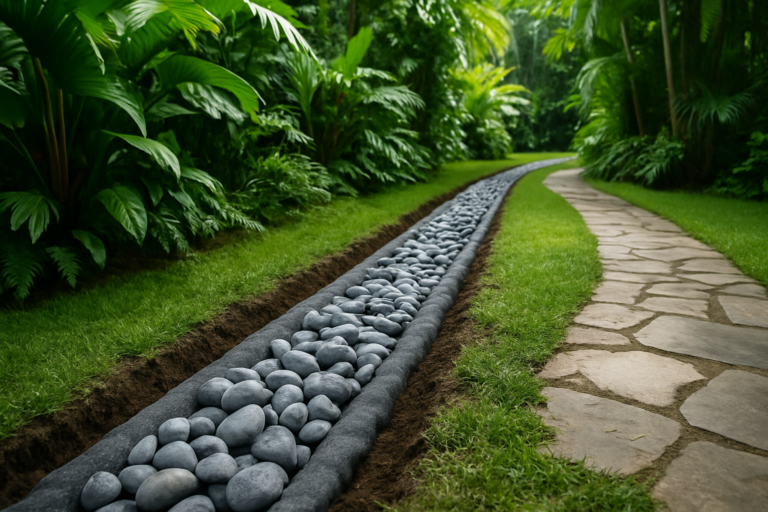
- Add channel or French drains to intercept water at the top of a slope and carry it away safely.
- Create swales — shallow planted channels that slow, spread and soak water rather than letting it rush.
- Improve infiltration by decompacting and adding organic matter so soil drinks rain instead of shedding it.
Where erosion is driven by concentrated flows, the answer is usually proper drainage works to capture and route water before it scours the ground.
The Singapore angle
Our climate makes erosion control a year-round concern rather than a seasonal one. Intense, frequent rain means any bare slope is vulnerable after the next storm, so covering ground quickly is the priority. Fast plant growth is an advantage — ground covers and turf establish rapidly here once given the right conditions. Drainage matters more than in temperate climates because the volumes are high; downpipes and paved areas concentrate a lot of water that has to be managed. On condominium and strata properties, slope stabilisation and retaining works usually involve the MCST or managing agent, and significant retaining structures may need engineering input and approval. If silt is washing into public drains, that’s worth addressing promptly. We assess slope, soil and water flow together so the fix addresses the cause, not just the symptom.
A simple action plan
- Stop the source — redirect downpipes and concentrated runoff away from bare soil.
- Cover bare ground fast with mulch, ground cover or turf.
- On slopes, add matting while planting establishes, and terrace if needed.
- For steep or failing slopes, install proper retaining and drainage.
- Keep soil healthy and planted so it stays absorbent and bound.
What it costs, roughly
It ranges from very little — mulch and ground-cover planting are inexpensive — to a significant investment for engineered retaining walls and drainage on a steep slope. Treat any figure as indicative; the right approach depends on the severity. As a rough guide, planting-based fixes are the most affordable, while structural slope stabilisation sits much higher. Tackling the cause early usually costs far less than repairing a collapsed slope later. A site assessment gives an accurate picture.
Frequently asked questions
What is the fastest way to stop soil erosion in my garden?
Cover the bare soil. Mulch and dense ground-cover planting are the quickest, cheapest defences — they break the rain’s impact and bind the surface. At the same time, redirect any downpipes or concentrated runoff away from the vulnerable area.
What plants are best for stopping erosion on a slope?
Dense, spreading ground covers combined with deeper-rooted shrubs and clumping plants work best, as the roots bind the soil at different depths. Choosing species suited to the slope’s sun and moisture helps them establish quickly in our climate.
Do I need a retaining wall to stop erosion?
Not always. Gentle slopes are usually solved with planting, mulch and drainage. Steeper or failing slopes may need terracing or a properly engineered retaining wall with drainage behind it. The right solution depends on the gradient and how much soil is moving.
Why does water keep washing soil onto my path?
It’s usually concentrated runoff — from a downpipe, a paved area or the top of a slope — flowing across bare soil. Intercepting that water with a channel or French drain and covering the soil with planting or mulch typically solves it.
Losing soil to runoff or worried about a slope? We assess and fix erosion across Singapore with the right mix of planting, drainage and retaining works. Explore our drainage works service or get in touch for a site assessment.